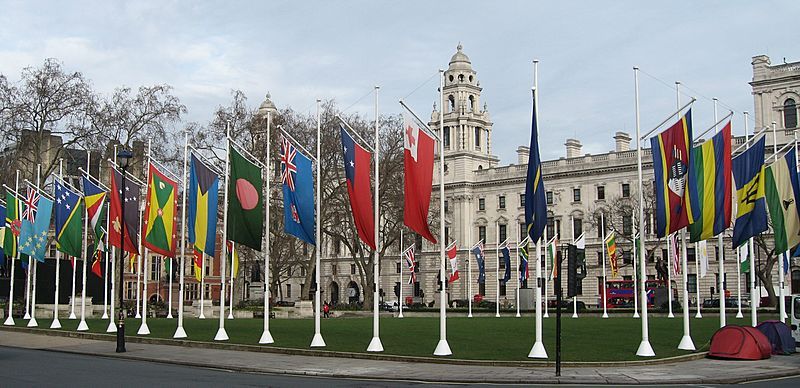
Reading: From the British Empire to the Commonwealth of Nations
Language support
British Empire - Britisches Weltreich
colony – Kolonie
trading post - Handelsposten
a quarter - ein Viertel
to spread widely - sich weit verbreiten
to weaken - nachlassen, schwächer werden
independent - unabhängig
connected - verbunden
head of state - Staatsoberhaupt
In the past, Britain was a very powerful country.
The British Empire
started in the late 1500s and early 1600s when England began setting up colonies and trading posts
overseas. By 1920, the empire covered about 35.5 million square kilometers. This was about a quarter of Earth's total land area.
Because of this, the English language, laws, and culture spread
widely. People often said, the empire on which the sun never sets
. This meant the sun was always shining on at least one part of the empire.
After World War II (1939 - 1945), Britain's power weakened. Many countries wanted to become free and independent.
India, its most important colony, gained independence in 1947. Slowly, the British Empire ended.
But many of the countries decided to stay in contact and work together. These countries joined the Commonwealth of Nations — or just the Commonwealth.
Today, the Commonwealth of Nations is a group of 56 countries from all over the world. Most of these countries were once part of the British Empire. They are connected by their shared history, the English language, and similar cultures.
Some of them still have the British King as their head of state, but most are independent.
...Was ist eigentlich
eine Kolonie???